 |
| Icy creek along Herman Creek |

Showing posts with label Columbia Gorge. Show all posts
Showing posts with label Columbia Gorge. Show all posts
January 23, 2013
Spared from a frigid hike out of Herman Creek area; beware of ice covered creek crossings

December 25, 2012
Zigzagging short climb up Wahkeena Falls Trail in the rain well worth the effort
.jpg) |
| Wahkeena Creek rumbling and tumbling below the bridge while water falls plunge above the bridge |
November 27, 2012
Trail Science 101: Trail Design
In a previous post a few days ago I said I would be writing a series of posts on “Trail Science.” This is the first installment following my introduction into what I like to call Trail Science.
According to the U.S. Forest Service’s Trail Construction and Maintenance Notebook, “There is a real art to trail layout.” It goes on to say that it takes a lot of experience to acquire an eye for proper trail building.
A particular trail’s specifications depend on several things, including what recreational activities will be performed on the trail, the amount of use and the characteristics of the trail’s particular landscape.
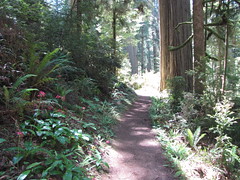 |
| Typical hiking trail path in the redwood parks. (Photo credit: Kid Cowboy) |
The steepness of a hill or mountain gives a trail its difficulty quotient. The steeper the hillside, the more excavation will be needed to cut in a stable backslope. The trail’s grade on a steep hill also has a direct bearing on how much design, construction, and maintenance work will be needed to establish solid tread and keep it solid.
It is a general rule in trail building that a high-use trail should be built with a 5-10 degree grade. I can guarantee that no one told the builders of the trail up Mount Defiance, located on the Oregon side of the Columbia Gorge, of this rule. When 20 degrees or more, a trail becomes very difficult to maintain, let alone hike.
A trail should also be “aesthetically functional,” meaning it takes advantage of an area’s characteristics, making it appear as though it just appeared. It fits the setting.
A basic rule in trail design is the he half rule. It says that the trail grade should be no more than half the sideslope grade of the hill it is on. For example, if a hill has a 6-percent sideslope, the trail grade should be no more than 3 percent.
There are many other rules and specifications in the science (or art) of trail building. Those are more appropriate for upper level work, not the 100 series I will present to you in the coming days.
Next: Water - a trail's nemesis

October 12, 2012
Want a workout? Try Mt. Defiance on for size
.jpg) |
| Near the summit of Mt. Defiance, looking down into the Columbia Gorge |
Subscribe to:
Posts (Atom)